ENERGY PRICES
Crude Oil Price Today: Price, Trends and Forecast 2026 | Tacto
14.09.2026
Current crude oil price based on the ICE Brent front-month future (104.61 USD/bbl as of 11 September, up 17.7 percent on the month). Trend analysis on the stalled corridor diplomacy and the adjourned Salalah meeting, the escalated tanker war, the 7.26 million b/d OPEC+ output gap, and the diverging demand forecasts from the IEA and OPEC. Scenarios and procurement recommendations for European industrial buyers.
AT A GLANCE
- Brent closed at 104.61 USD/bbl on 11 September, up 17.7 percent on the month; on 14 September the November contract stood at 107.60 USD/bbl after the Salalah talks were postponed (Handelsblatt).
- The corridor is not in force: the foreign ministers' meeting at which Iran and Oman were to present the agreement was adjourned on 14 September, and Saudi Arabia pre-emptively shut the East-West pipeline after drone attacks.
- On 11 September the IEA reported OPEC+ output of 33.11 million b/d in August, 7.26 million b/d below target, of which Saudi Arabia alone accounts for 4.45 million b/d; global stocks have drawn 507 million barrels since February.
- OPEC+ is holding October output at September levels (decision of 6 September, next review 4 October). Supply policy is predictable; the outages are not.
Contents
What is moving the price right now?
The bet on diplomacy has not paid off. Our last issue described a market pricing in the Iran-Oman corridor concept and pushing Brent down to 89.31 USD/bbl. Two weeks later the front month stands at 104.61 USD/bbl, up 17.7 percent on the month, and on 14 September the November contract traded at 107.60 USD/bbl. The reason was visible the same day: the foreign ministers' meeting in Salalah, Oman, at which the corridor agreement was to be presented, was adjourned in the interest of reaching consensus, and Saudi Arabia pre-emptively shut the East-West pipeline that normally bypasses the strait after drone attacks (Handelsblatt).
In between sits an escalation that has earned the name tanker war. On 5 September US forces struck three Iranian oil tankers; the Revolutionary Guard reported counterstrikes on three tankers and three US-linked vessels, and Aramco's Jizan facilities were hit for the second time that month. Traffic through the strait has shrunk to a trickle: on 7 September Al Jazeera reported an average of ten commodity ships a day over the preceding ten days, with individual days of five, six and eleven transits. For comparison, before the war around 3,000 vessels passed through per month.
Supply is now split in two, and the IEA quantified it on 11 September. OPEC+ produced 33.11 million b/d in August, 7.26 million b/d below its own target, with Saudi Arabia alone 4.45 million b/d and Kuwait 0.62 million b/d short; Russia produced 8.36 million b/d, 1.53 million b/d below target, after intensified attacks on refining and export infrastructure. Quota policy has become predictable while actual output has not. Formally, seven OPEC+ states held October output at September levels on 6 September and set the next review for 4 October.
The stock side shows how long this has been running. The IEA reports global inventories drew 95 million barrels in August; since February the cumulative draw comes to 507 million barrels, averaging 2.8 million b/d. US crude stocks stood at 424.1 million barrels in the week to 4 September, down 0.4 million on the week. Iranian floating storage is running down too: from around 90 million barrels in mid-July to about 29 million barrels in early September, on loading rates of 220,000 to 255,000 b/d in August against roughly 2 million b/d in March.
On the demand side the two big forecasts continue to diverge, and both point down. The IEA expects global oil consumption to fall by 2.5 million b/d in 2026, concentrated in middle distillates and petrochemical feedstocks in Asia, with a 2.6 million b/d recovery in 2027. OPEC cut its 2026 growth forecast to 380,000 b/d in September, the fifth consecutive reduction. A market with shrinking demand and rising prices is a market driven purely by supply risk.
What we watch: whether the adjourned Salalah meeting is rescheduled, daily transit counts, the restart of the Saudi East-West pipeline, the OPEC+ meeting on 4 October, and how long Iranian floating storage lasts.
Energy prices in your inbox
Every two weeks: Price trends, market analysis, and negotiation tips — for procurement teams. Free and easy to cancel.
What does this mean for procurement in Europe?
The lesson of the last four weeks belongs in your hedging rule: diplomatic announcements are not a trigger, implementations are. Anyone who deferred cover at the end of August on the strength of the corridor concept is paying 17 percent more today. Define the trigger for your next tranche as a verifiable event, such as a first documented transit under the corridor agreement or a week with more than 50 transits, rather than as news of a planned meeting.
Cover oil-linked inputs in partial volumes now instead of waiting for a pullback. Plastics, lubricants, packaging and freight costs follow Brent with a lag; the increases off the September level are not in your prices yet, they arrive in the fourth quarter. Staged cover spreads the entry risk, and the alternative is the spot market in a market whose supply side depends on individual drone strikes.
Check every oil-indexed clause for symmetry and averaging now, in the opposite direction from August. Then, monthly averaging slowed the pass-through of the rise; now the same mechanism delays a price impulse that is already in the market. If you contracted on a single reference date, you should know today which date applies. The basis remains the ICE Brent monthly average with an expiry date, not the daily quote.
Negotiate fuel and freight surcharges against your supplier's cost base rather than as a flat figure. A surcharge calculated on August's 89 USD/bbl is too low today and will be reclaimed; one that permanently assumes the 107 USD/bbl of 14 September is too high. Agree a formula with a reference index, an adjustment interval and an expiry date, instead of arguing about amounts.
Treat the demand forecasts as what they are: an argument for the period after the war. The IEA and OPEC both see weaker demand, and the IEA expects an outright decline of 2.5 million b/d in 2026. Once the supply risk falls away, the price will fall faster than demand can support it. That argues for limiting hedges in time and not fixing beyond 2027.
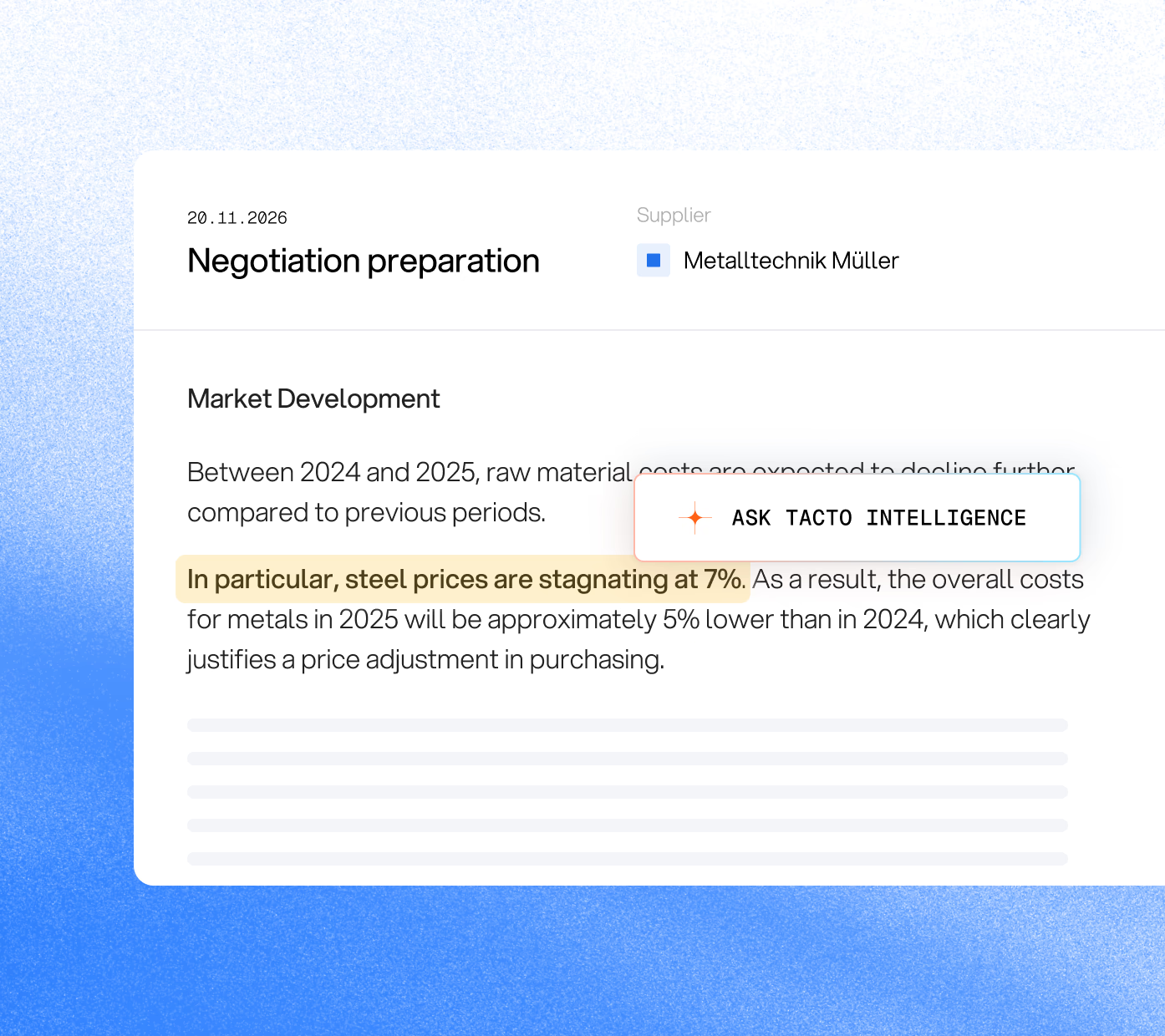
Tacto Intelligence connects your ERP data with over 20,000 commodity and market indices — including steel, cold-rolled, galvanized, energy, and freight. Identify in real time which categories in your portfolio are affected by current market movements.
>20,000
Price indices integrated
75%
less preparation effort
>5,000
Price increases deflected with the Defender Agent
Crude Oil Price Outlook: Assessment from Our Procurement Intelligence Team
Base Scenario
In this band over the next four to six weeks. (1) The corridor is not in force, the Salalah meeting was adjourned on 14 September and the Saudi East-West pipeline is shut, (2) traffic through the strait runs at around ten vessels a day and reacts to every individual attack, (3) OPEC+ is holding October output at September levels but producing 7.26 million b/d below target, (4) weak demand caps the upside: the IEA expects a 2.5 million b/d decline in 2026 and OPEC has cut its growth forecast to 380,000 b/d.
Risk Scenario
Attacks reach further export infrastructure in the Gulf, the Saudi East-West pipeline stays shut for longer, or transits fall below five vessels a day. Iranian floating storage, now around 29 million barrels, removes another source of supply as it empties. Probability 30 to 35 percent over the next three months. A rescheduled and implemented corridor agreement would conversely open the way below 95 USD/bbl.
Related Energy Prices
Related Procurement Glossary Topics
Frequently Asked Questions
Because crude oil in industry typically feeds into cost structures not directly but through materials, chemicals and logistics. For procurement, the consumer price is not the decisive reference; what matters is the crude benchmark and how it transmits through supply chains.
When the supplier can demonstrate a clear link to Brent, petrochemical feedstocks or transportation costs. Less plausible are blanket increases without a clear cost logic.
Primarily petrochemical-adjacent categories such as plastics, packaging, chemicals, resins, coatings, lubricants, and logistics or freight surcharges. These are the categories where Brent impacts European industrial procurement most directly.
Because ICE Brent is the relevant international crude benchmark for European industrial procurement. Retail fuel and heating oil prices include additional national and downstream price components, which makes them far less suitable for evaluating procurement risks and cost escalation clauses. WTI is reported only as US comparison context.


