Webinar
Webinar Recording: Price Under Control – Commodities, Risk, and Hedging for Modern Procurement
Iran conflict, Hormuz blockade, UAE's withdrawal from OPEC, China's export controls on rare earths, and new US tariffs: Procurement is currently facing several simultaneous crises that are impacting raw material prices, energy costs, and logistics capacities in various ways. The webinar demonstrates how procurement organizations can understand the causal chains behind the headlines, distinguish legitimate from excessive price increases, and counteract them with concrete tools.
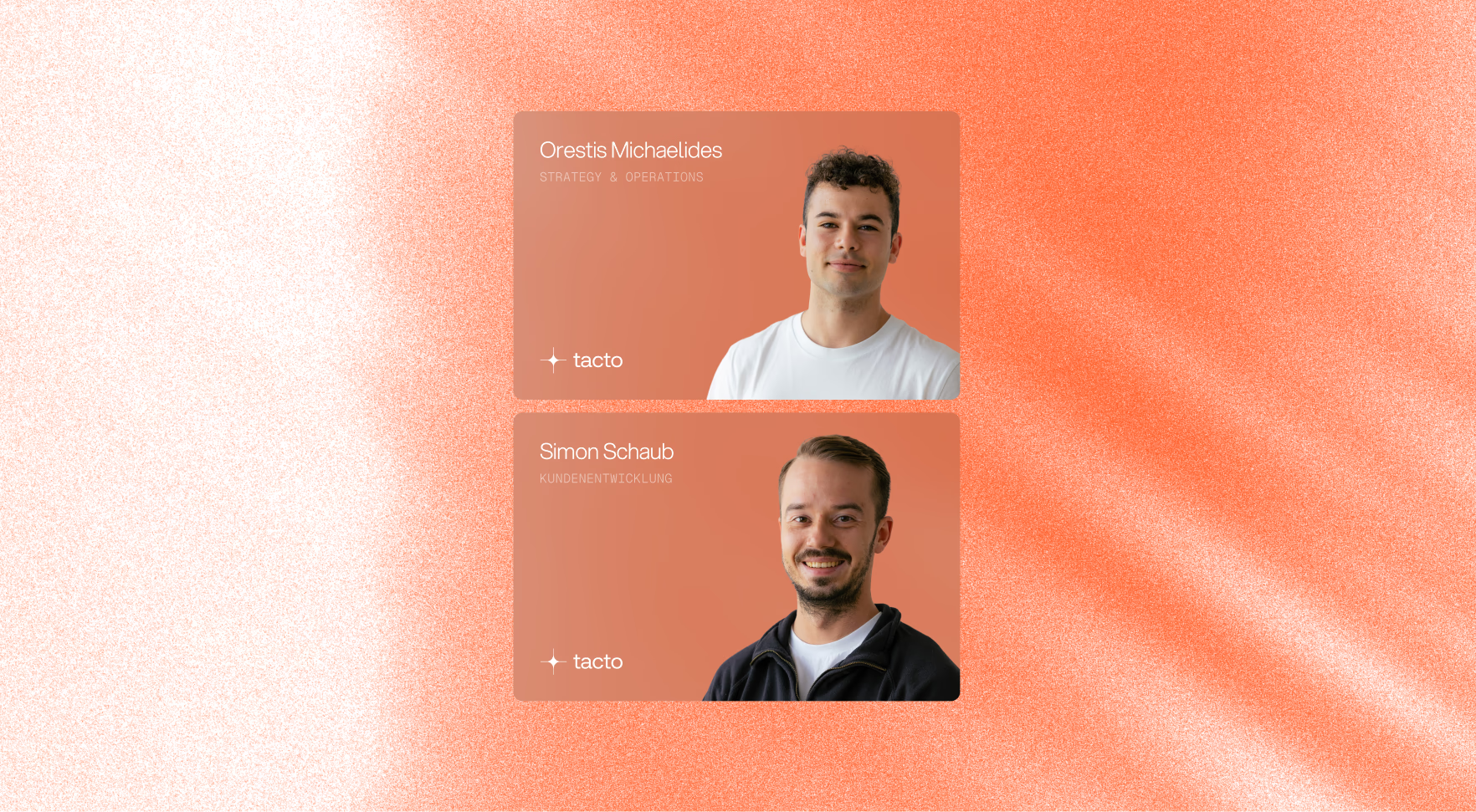
Simon Schaub (Customer Development, Tacto) and Orestis Michaelides (Strategy & Operations, Tacto) contextualize the current geopolitical situation, analyze its impact on industrial supply chains, and present both proactive and reactive strategies for procurement. Practical examples from Sonax and Hauraton illustrate the concrete implementation. A demo will introduce the Defender Agent, which automates data-driven responses to price increase requests.
Four crises simultaneously: why the current situation particularly challenges procurement
Orestis Michaelides contextualizes four geopolitical developments currently impacting procurement simultaneously. The blockade of the Strait of Hormuz jeopardizes 14 million barrels of oil per day, representing 20% of global fuel. The UAE's withdrawal from OPEC removes up to one million barrels from the organization's daily production quota, making oil price formation structurally more unstable. China's control over approximately 90% of global rare earth production remains a long-term supply risk: Around 80% of large European companies have a Chinese producer in their supply chain. Additionally, US tariffs of 25% on vehicles and 50% on steel and aluminum could burden the German automotive industry alone with up to 15 billion euros annually. The result: Over a third of companies are already reporting concrete delivery delays for intermediate products and raw materials.
Understanding causal chains: from oil prices to packaging film
The webinar uses two examples to illustrate how geopolitical crises can impact seemingly unrelated product categories across multiple value chain stages. In the first case, a disruption in oil supply, via naphtha and basic chemicals, leads to a 20 to 30% increase in plastic granulate prices within two months (example). A packaging film supplier then demands a 15% surcharge. The crucial question for procurement: If the plastic component accounts for 50% of the film costs and the granulate increases by 20%, only 10% is mathematically justified, not 15%. The second example demonstrates a domino effect in logistics routes: Blocked sea routes not only result in higher fuel, insurance, and crew costs on alternative routes but also tie up global freight capacities. A truck that takes eight days instead of five is unavailable for its second trip. Even crisis-free routes become more expensive as a result.
From reacting to controlling: five maturity levels and concrete tools
Simon Schaub presents a five-stage maturity model: from purely order-driven organizations (Level 1), which do not explicitly track raw material exposures, to proactive management (Level 5), which leverages market volatility as a negotiation tool. On the proactive side, tools range from early warning systems and scenario planning, strategic stockpiling, and framework agreements with price escalation clauses, to financial hedging via futures and swaps. Reactively, cost structure analyses, index comparisons, alternative offers, and partial acceptance with index linkage are available. Two customer examples illustrate the implementation. Sonax, winner of the BME Procurement Excellence Award 2023, conducted a cross-departmental risk analysis and identified 57 critical risk items. For one raw material, a contract was signed at 1.23 Euros per unit, and the total quantity was called off prematurely. When the market price rose to almost 3.00 Euros due to the Middle East crisis, Sonax was still able to procure at the agreed price without supply bottlenecks. Hauraton, in turn, received a blanket price increase of 8% citing rising raw material and energy costs. Their own cost structure analysis showed: 50% of the item's value was attributable to cast iron, plus steel, plastic, and small parts. After breaking down the individual cost drivers, only a 5% increase was justified. Three percentage points were successfully averted.
Automated Price Defense with the Defender Agent
The session concludes with a demo of the Defender Agent, which, as part of the negotiation cockpit, automatically responds to price increase requests. The process: An incoming price increase request is forwarded to the Agent via email. It analyzes the demand based on over 20,000 market indices and historical supplier data from the ERP system. Within minutes, it generates a personalized response letter with data-driven counterarguments. In the example shown, a 3.6% demand is rejected because the relevant indices are declining. The buyer can iteratively adjust the tone and arguments. The letter is sent only after human approval.
Conclusion
The webinar highlights that the current volatility in commodity and energy markets presents procurement with a choice: reactively address individual price increases or systematically build transparency to distinguish legitimate from excessive demands. Practical examples from Sonax and Hauraton demonstrate that proactive risk management and data-driven negotiation deliver measurable results. The Defender Agent automates the most time-consuming part: the fact-based creation of price defense letters.
Simon Schaub and Orestis Michaelides from Tacto contextualize the geopolitical crises surrounding Hormuz, OPEC, rare earths, and US tariffs, and demonstrate how their ripple effects impact industrial procurement across multiple stages.



