Webinar
Webinar recording: AI starts in procurement - How buyers become the pioneers of their company with Sourcing Intelligence
Companies are pouring billions into AI, yet most still cannot show a measurable return. Many procurement departments are therefore asking where AI should start and how its value can be proven in euros. At the same time, a strategic buyer today can actively manage only around 20 percent of their items, while the rest runs without active management.
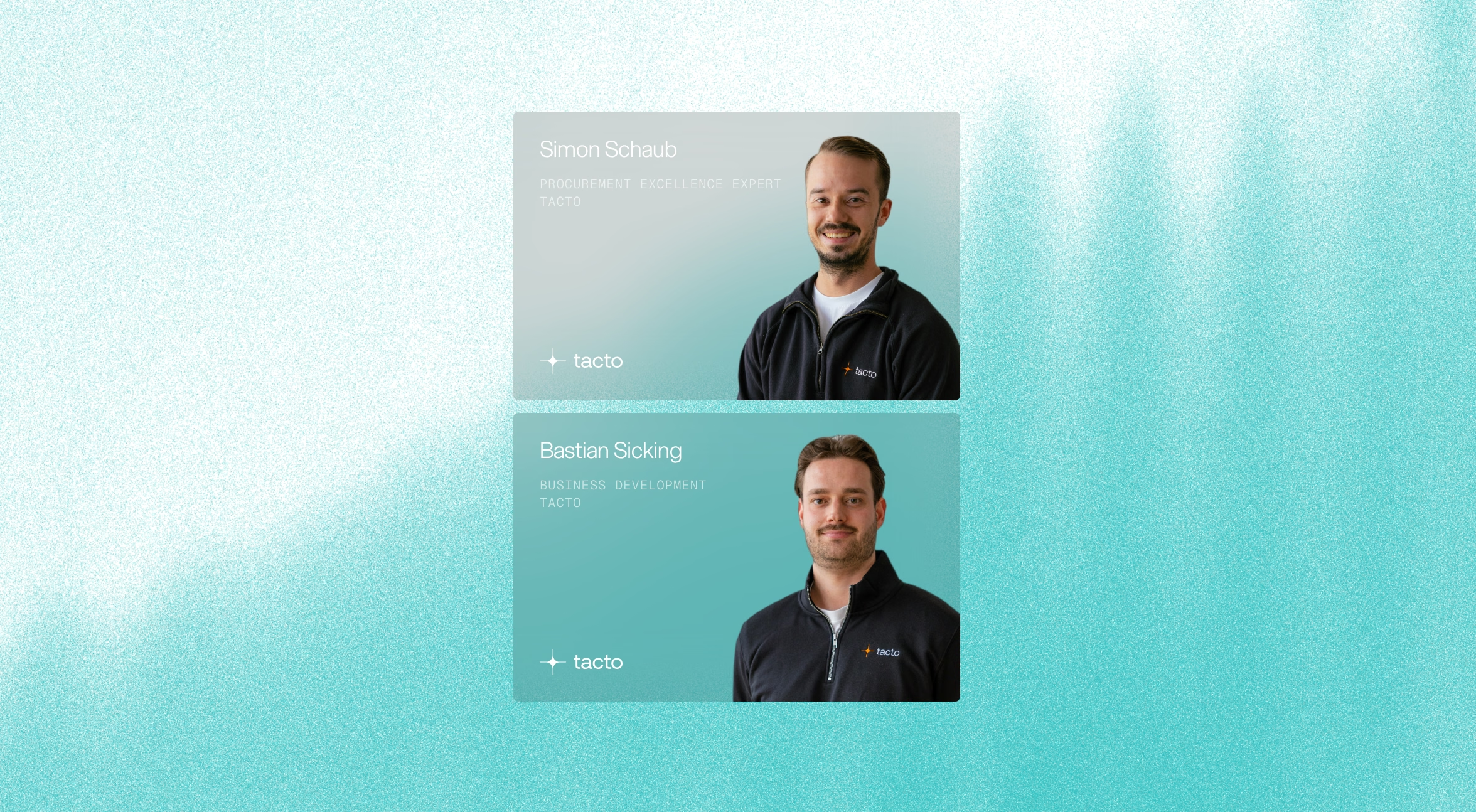
Bastian Sicking (Business Development Benelux at Tacto) and Simon Schaub (Procurement Excellence Expert at Tacto) show why procurement is the best starting point for AI in a company, how AI agents with Sourcing Intelligence take over sourcing from demand to ERP, and how this changes the role of the buyer.
Four conditions: Why AI starts in procurement
For AI to pay off, Tacto sees four conditions that have to come together: proximity to data, automatable processes, a clearly measurable ROI and value beyond one department. Comparing the typical functions of a manufacturing company, only procurement meets all four. Prices, volumes, suppliers and contracts exist for every part, processes such as RFQs and order confirmations repeat constantly, and procurement connects engineering, production, finance and sales. The financial lever is large as well: every euro saved in procurement lands directly in EBIT. At a 20 percent margin, sales has to sell around 5 euros more to achieve the same effect. The IT hurdle is low, because the start works with an ERP export instead of an integration project.
The status quo: 80 percent of items run without active management
Simon Schaub sees a recurring pattern with customers, for example in machine building: a strategic buyer can actively manage around 20 percent of their items, with market research, alternative suppliers and an eye on quality and delivery. Managing all of the roughly 540 items per buyer would take around 1,080 working days, while 220 are available. Using the example of a company with 120 million euros of spend, he shows what this costs: 27 percent of the spend, or 32.4 million euros, is not actively managed. Overpaying by around 10 percent on it means 3.24 million euros of missed savings per year. On top come around 700,000 euros of process costs for manual RFQs that only cover A parts and still tie up the whole team. Together, the status quo costs around 4 million euros a year.
Sourcing Intelligence: AI agents from demand to ERP
The foundation is the Procurement Brain, a data layer built from five sources: ERP data such as the item master, purchase history and contracts, supplier and process data, external market data with more than 20,000 price indices, world knowledge from the model and the buyer’s strategy. More than 250 specialized agents work on top of it. With Sourcing Intelligence, a trigger such as a new requisition, an expiring contract or a Savings Radar alert starts the process. Agents find suitable suppliers based on item attributes, order history and past RFQs, request quotes and run first negotiation rounds. The buyer receives an award proposal weighed by price, total cost of ownership and logistics, decides, and the result is written back to the ERP as an info record or framework contract. The company itself defines where a buyer approves, per category, value limit or process step. In the live demo, Simon Schaub showed two cases: a first-time demand for 250 turned parts, for which the agent derived a should-cost model as target price from the drawing, sent RFQs to three qualified suppliers and renegotiated, and a price increase above the market development that was backed by a market RFQ for the upcoming annual negotiation. For the example company, this adds up to around 4 million euros a year, from 3.24 million euros of realized savings and 580,000 euros of saved process costs.
From processor to orchestrator: The new role of the buyer
When agents prepare RFQs, quote comparisons and negotiations, the working day starts with decision-ready cases. The time freed up goes into four strategic tasks: category strategies with full market transparency, supplier development, design to cost together with engineering and resilience in global supply chains. The buyer sets rules and limits for every part, works more closely with engineering, finance and sales and is measured by EBIT impact and security of supply. Asked in the poll what holds AI in procurement back most, almost all participants named scattered or unclean data. Simon Schaub sees no reason to wait, because AI helps clean data more efficiently and detect poor data quality faster.
Conclusion
The webinar makes clear that procurement has everything it takes to lead the way on AI in a company: data, recurring processes and value that shows up directly in EBIT. What matters is bringing the previously unmanaged part of the spend into competition with agents, while clearly defining where the buyer decides.
Bastian Sicking (Business Development Benelux at Tacto) and Simon Schaub (Procurement Excellence Expert at Tacto) show why AI starts in procurement, what the status quo with 80 percent of items not actively managed costs, and how AI agents with Sourcing Intelligence take over RFQs, negotiations and awards. For a company with 120 million euros of spend, this adds up to around 4 million euros a year, with the buyer as the orchestrator of the agents.