Webinar
Webinar recording: From gut feeling to evidence-based proof: AI-generated negotiation arguments in practice - Insights from the Miele Group
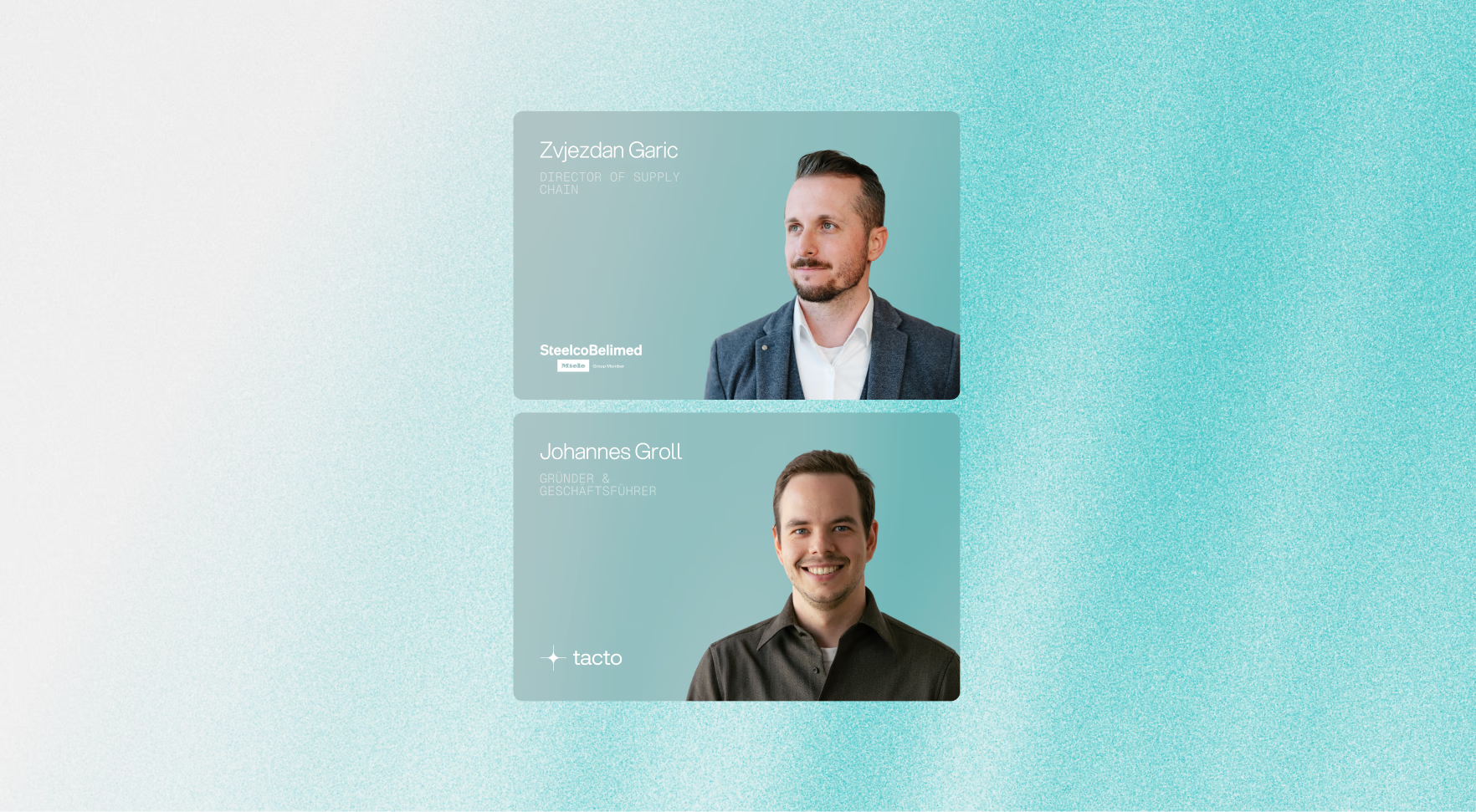
Procurement negotiations are often based on experience, intuition, and fragmented data. However, as supply chains, markets, and price structures become more complex, an objective, data-driven foundation becomes increasingly critical. In our webinar, "From Gut Feeling to Evidence-Based Negotiation," Zvjezdan Garic (Director of Supply Chain, Steelco Belimed – Miele Group), Johannes Groll, and Florian Findeis (Tacto) demonstrate how AI helps ground negotiation arguments in facts—significantly boosting procurement efficiency.
The Starting Point – When experience alone is no longer enough
Many procurement organizations face the same challenge today: increasing complexity, growing demands, and a high administrative burden in day-to-day operations. Price changes, market shifts, and supplier data are scattered across different systems—consolidating this information takes time that is then missing from negotiation preparation.
As a result, negotiations are often based on experience rather than clear, verifiable data. This makes it difficult to accurately substantiate price trends, support arguments, and systematically track negotiation outcomes.
AI as a tool for fact-based negotiations
For Steelco Belimed—part of the Miele Group—a key goal was to base negotiations more heavily on data and trends rather than manually aggregating information from various sources. This is exactly where the Tacto system provides support: internal procurement data, price histories, and supplier records are linked with external market and commodity indices, providing insights that are ready to use for immediate preparation.
A major advantage for Steelco Belimed: AI agents handle part of the analytical workload, monitoring price and volume trends in the background and flagging anomalies early on. This generates insights that are easily overlooked in daily operations—insights that can be directly integrated into negotiation strategies and arguments.
Key features in use at Steelco Belimed:
- Price and trend analysis: Relevant changes are automatically highlighted, eliminating the need for manual evaluation.
- Market trends in context: External indices complement internal data, making the root causes of price shifts clearer.
- Actionable negotiation levers: Insights regarding volumes, timing, or payment terms.
- Centralized documentation: Results, dossiers, and analyses are stored in a standardized format, ensuring they are transparent and accessible to the entire team at all times.
Preparation becomes noticeably easier: instead of gathering information, the team at Steelco Belimed can focus more on interpreting data and professional assessment. The AI provides the facts – procurement puts them into the right context.
From individual gut feeling to structured argumentation
In practice, Steelco Belimed (Miele Group) uses a combination of AI analysis and negotiation dossiers to base procurement decisions on clear, verifiable data.
The team can analyze price trends, supplier developments, and market indices at the touch of a button, allowing them to argue with greater precision – independent of personal experience.
Crucially, the AI does not make automated decisions; instead, it provides targeted support for the buyers' professional expertise. Insights are reviewed, categorized, and integrated into individual negotiation strategies.
This creates a new form of collaboration between human and machine: AI provides the facts, and procurement puts them into context.
Conclusion
The example of Steelco Belimed (Miele Group) shows how data-driven structures can noticeably simplify the preparation and execution of negotiations. Instead of manually compiling information, standardized analyses and clear foundations for argumentation are readily available – and results are documented in a transparent, traceable way.
In this webinar, Zvjezdan Garic (Steelco Belimed, Miele Group), Johannes Groll, and Florian Findeis (Tacto) discuss how experience-based knowledge is transformed into a robust, data-driven foundation for argumentation – and how AI empowers procurement to act faster, more precisely, and with a greater focus on facts.