Webinar
Webinar recording: The AI decision in procurement. In-house development project or ready-to-use AI agents?
New AI models are released almost every week, and the barrier to building a first solution of your own has never been lower. In software development, 40 percent of all changes are now made with an AI agent according to GitHub Octoverse 2026, up from 17 percent in March 2026. For procurement departments, this raises a new question: Is it worth developing AI applications in-house, or do ready-to-use AI agents deliver reliable results faster?
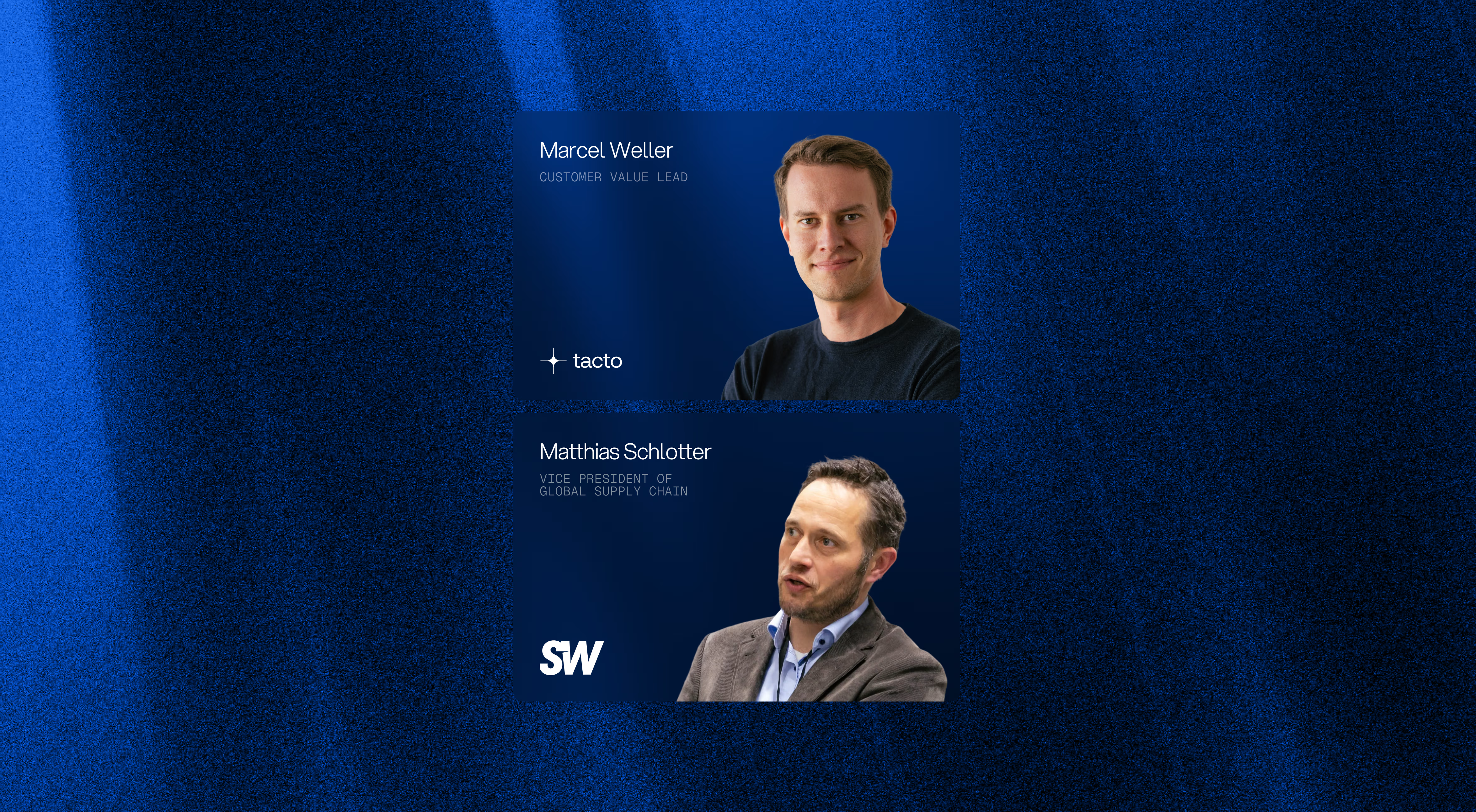
Matthias Schlotter (Vice President of Global Supply Chain at SW) and Marcel Weller (Customer Value Lead at Tacto) show in the webinar where in-house development works in procurement, where it reaches its limits and how connected AI agents support a sourcing process from design to award.
AI in procurement: Widely used, rarely stable in daily operations
The poll among participants shows how widespread AI in procurement already is: 55 percent mainly use Microsoft Copilot in their daily work, around 21 percent ChatGPT, Claude or similar chat tools and 11 percent self-built solutions or their own agents. However, the applications run stably in daily operations for only about a quarter. For more than 75 percent, results often have to be checked again or the use is limited to individual trials. Participants named approvals from IT, data protection and the works council, scattered data and a lack of team capacity as the biggest hurdles.
Studies confirm the picture: Only one in three internally built AI tools makes it into live operation, compared with two in three purchased solutions (MIT NANDA 2025). 45 percent of AI-generated code contains security vulnerabilities (Veracode 2025), and 60 percent of software costs arise after launch, for operation and maintenance (IEEE). Anyone who wants to move from a first prototype to a solution for the whole team therefore has to clarify how it scales to further suppliers, how consistent quality is ensured, where external market and index data come from and who maintains and develops the solution over time.
Copilot in Excel: How SW automatically assigns new parts to commodity groups
SW is one of the leading manufacturers of manufacturing systems for metalworking, with around 1,600 employees, more than 400 million euros in revenue and its own procurement teams in Germany, China and North America. Matthias Schlotter knows one process from every position he has held in procurement: For every new part, master data has to be maintained and a commodity group assigned. The task is unpopular, and the list of open entries kept growing because delivery issues and negotiations took priority.
SW therefore gradually set up the assignment with Copilot in Excel and Claude Opus 5. A system prompt contains rules and exceptions, and a reference Excel file continuously adds further examples. Accuracy is around 80 percent, the assignment has become much faster and the list of open entries much shorter. Limits appear with unclear names such as “bracket” or “cover plate”, because the solution only evaluates text data and no 3D data. An attempt to automate the task as an agent directly in Copilot produced limited results and was stopped. The approach still works because of the task itself: It recurs, the result is easy to check, and a wrong commodity group can be corrected before the order without any disadvantage for the company.
When in-house development pays off
From this example, Marcel Weller and Matthias Schlotter derive criteria for building in-house: The task recurs and follows clear rules, the result can be checked at a glance, and errors can be corrected afterwards without triggering a cash outflow. Added to this are a manageable group of users, data in one place and low maintenance effort.
Complex use cases look different. Using a fictitious cost breakdown for a hexagon bolt, Marcel Weller shows that a general language model estimates the cost shares plausibly but relies only on general knowledge and public indices. This accuracy is not sufficient for a negotiation with the supplier. Reliable values require tolerances, manufacturing processes, revisions, country-specific labor costs and indices for the exact alloy. Tacto uses specialized agents for each cost item that access market indices, benchmarks and machine hour rates, supported by a team of cost engineers.
Connected procurement intelligence: From part to Perfect Buy
The foundation for connected agents at Tacto is the Procurement Brain. It combines internal data such as transaction and master data from the ERP, contracts, drawings and emails with external market data, supplier information and risk data, complemented by benchmarks from more than 400 procurement organizations and more than 20,000 market indices. All agents share this context: In a negotiation, they know not only the order history and prices but also a supplier's quality, on-time delivery and commodity group strategy.
In the demo, Marcel Weller shows what this looks like in the process. Already during design, Tacto calculates a target price for a drawing part by lot size, manufacturing country or in-house production and shows similar items with their historical prices. In the Sourcing Intelligence module, an agent then takes over the request for a new flange housing: It reads out bores, tolerances and material, suggests suitable suppliers from the existing pool and new ones via web search, sends the requests, takes over quote data from PDF files, runs automated price rounds and prepares the award with a scoring analysis of price, delivery date and quality. Procurement itself defines how autonomously the agent works through intervention limits and approvals.
Conclusion
The example of SW shows that in-house developments in procurement work well where tasks are recurring, clearly defined and easy to check. In addition to commodity group assignment, SW also uses Copilot to evaluate various data sources and give suppliers better forecasts. As soon as several departments and systems such as ERP and PLM come together, in-house development reaches its limits without dedicated specialists. The key is to test simple use cases in-house and tackle complex processes with specialized agents, so that buyers can hand off routine tasks and gain more time for strategic work and supplier contact.
Matthias Schlotter (Vice President of Global Supply Chain at SW) and Marcel Weller (Customer Value Lead at Tacto) show how SW correctly assigns around 80 percent of new parts to commodity groups with Copilot in Excel, which criteria make in-house development worthwhile and where it reaches its limits. The demo shows how connected AI agents support a sourcing process from target price calculation during design to award.